Mars, Venus, and The Crescent Moon

It’s dangerously cold outside, but on the way home looking west, I noticed the moon and a bright object next to it with a dimmer object just above that. It turns out, Venus is putting on a show tonight to the left of the moon with Mars appearing above Venus. David Dickinson has a close up photo showcasing these celestial objects.

Freight Train Hopping in Brazil

The man known as Wizehop on Youtube, recently published his Brazil train hopping adventure video. It’s a two-hour movie with site seeing, adventure, danger, and at times, mind bending education.

In the video, you see what it’s like to navigate the streets of Brazil where even the locals are afraid for their lives. The video highlights the congested nature of Brazil’s railways and the lack of law and order. It’s a raw look into time, space, and a part of the soul that wants to wander beyond the next bend.

Outside of the music overpowering his voice at times, I thoroughly enjoyed the video. If you’re into freight train hopping or want to see Brazil from a new perspective, definitely watch the video.

I Feel Sorry For Matt Slack

With the rise in popularity of SlackHQ as a collaborative chat environment for teams, a lot of people mistakenly Tweet to @slack when they have an issue instead of @SlackHQ. Apparently, Matt Slack is not a real-time messaging, archiving and search for modern teams.

I am not SlackHQ

I am not SlackHQ

Poor fellow. It reminds me of Brandon Kraft who uses the Twitter handle @kraft. I bet he gets his fair share of cheese tweets. By the way, his profile says (FYI- Not ).

The Accidental Journalist

Felix Salmon, who writes for Fusion.net, offers advice to would be journalists. Salmon explains the insurmountable difficulties new journalists face and the lack of pay to go with it. There’s a lot to his article, but the overall advice is to avoid a career in journalism.

I’m sure that many people have told you this already, but take it from me as well: journalism is a dumb career move. If there’s something else you also love, something else you’re good at, something else which makes the world a better place — then maybe you should think about doing that instead. Even successful journalists rarely do much of the kind of high-minded stuff you probably aspire to. And enormous numbers of incredibly talented journalists find it almost impossible to make a decent living at this game.

Salmon describes how he rose through the ranks writing for dry publications and eventually encountered some luck. I don’t have the same exact journey as his, but I too encountered luck.

When I wrote about Web 2.0 services in 2007, I chose WordPress to publish my content and was immediately struck by the WordPress fascination bug. The more I used it, the more curious I became about themes, plugins, and how it was developed.

I published blog posts chronicling my journey, sharing the things I learned. At the end of 2007, Mark Ghosh who owned Weblogtoolscollection.com contacted me out of the blue. He asked if I’d like to write for his website and get paid to do it. I have no idea how Mark discovered me, but his site was the largest publication devoted to WordPress at the time, so it was an opportunity of a lifetime for me.

I wrote for WLTC for at least a year, covering everything from news, to controversial topics in the community. Not once did I ever think I was a journalist. To this day, I struggle with calling myself a journalist because I don’t like the term and the baggage that comes with it, bearer of the truth and all.

The point is, I started off as a blogger and learned everything I could about WordPress as a user. I passionately shared my knowledge with an audience I didn’t quite know I had. It eventually afforded me a paid gig (this is the first lucky part). I agree with Salmon in that, the advice of five or six years ago of starting a blog and getting discovered is exceedingly difficult.

There’s no particular reason to believe that the best route to success is to first get your foot in the door churning out listicles, and then somehow work your way up the ranks. That might have worked for a few early BuzzFeed employees, but they, too, were lucky, winning the pick-the-right-startup lottery.

Similarly, there’s no particular reason to believe that the advice I’d give five or six years ago, which was basically “start a blog and get discovered”, still works. With the death of RSS, blogs are quaint artifacts at this point, and I can’t remember the last time I discovered a really good new one.

Personally, I hate the chains and shackles that come with the journalist title, at least the way I define the term. I just want to do what I’ve been doing for years; write about the things that interest me and if it happens to be similar to journalism, then so be it. I’d rather do that than actually be a journalist. Besides, what is a journalist anyway?

Salmon ends his post with somber advice:

If all you care about is the great journalism, then, well, go out and find great stories to tell, and tell those stories in a compelling manner. You’ll always be able to find somewhere willing to publish them, even if they pay little or nothing for the privilege of doing so.

On the other hand, if you’re more career-oriented, and want a good chance at a well-paid middle-class lifestyle down the road, I don’t really know what to tell you. Except that the chances of getting there, if you enter the journalism profession today, have probably never been lower.

Good luck to anyone out there pursuing a career in journalism, looks like you’ll need it.

WordPress’ Road To 50% Market Share and A Few Thought Experiments

Last week, I had the fortunate opportunity to attend my first PressNomics event in Phoenix, AZ. I had a great time, even if I fell ill after returning home. There were a lot of great sessions packed with useful information, but the granddaddy of them all was the on-stage interview between Pagely CEO, Joshua Strebel and Automattic CEO, Matt Mullenweg.

Since that memorable interview which I’m still kicking myself for not recording, there’s been a lot of discussion surrounding Mullenweg’s thoughts on Jetpack and its impact on growing WordPress’ marketshare to 50% or more. Prior to his appearance at PressNomics, Mullenweg appeared on the KitchensinkWP podcast hosted by Adam Silver, where he discusses how feasible it would be to obtain 100% marketshare.

The next goal is the majority of websites. We want to get to 50%+ and there’s a lot of work between now and then. As the percentage increases, it gets harder and harder to grow the market share, and we have to grow the market share by doing things we haven’t done in the past – really thinking about the onboarding process, really thinking about the integration with social networks, and with how WordPress works on touch devices, which is going to be the predominant computing platform of the future. These things are going to be really important.

What got us here isn’t going to get us there. Once we get to 50%, we can decide something new we want to do.

During his appearance at PressNomics, Mullenweg said that he’s, “Worried we have become too much of an inward facing community and afraid to make a painful leap forward to make the next WordPress.”

Outside of a very long and detailed thread on the Advanced Facebook Users group (you have to be a member to view the thread), no one has talked about this statement. Granted, I’m sure the Jetpack and market share comments have overshadowed it, but it’s worth exploring in its own right.

The Next WordPress

For starters, what is the next WordPress? I don’t know and I don’t even think Mullenweg knows, but maybe he has an idea. We know mobile is likely involved, but it’s anyone’s guess after that. Who’s to say the next WordPress will be WordPress? If you’ve listened to Mullenweg in interviews or even during the State of the Word when he answers questions about the future of WordPress, he routinely brings up Theseus’ paradox.

The ship of Theseus, also known as Theseus’ paradox, is a thought experiment that raises the question of whether an object which has had all of its components replaced remains fundamentally the same object. The paradox is most notably recorded by Plutarch in Life of Theseus from the late first century. Plutarch asked whether a ship which was restored by replacing each and every one of its wooden parts remained the same ship.

An interesting thought experiment for sure. However, for it to take place means WordPress would need to radically change in the next few years, which brings me to the other part of his statement.

Inward Facing Community

This is a highly controversial statement, one that only he knows more about. However, I think several people on the Advanced WordPress Group were close with their interpretations. As the group is closed, I can’t cite the names of the individuals without permission so instead, I’m quoting from several different comments I agree with.

If you think the version of PHP is important at all, you’re not going to create the next WordPress, meaning the next thing that’s as big or impactful as WordPress is.

Not enough community outreach or venturing outside of the WP community for innovative ideas taking WP to the next level, which I’d have to agree with– if that’s what he meant.

Most innovation is done outside in, not inside out. But to be honest Matt, that’s where the problem lies too… The “inside” is very negative towards change, constantly throwing up hurdles… They like small incremental steps, but fear bigger ones… – Joost de Valk

These interpretations mirror my own in that, the people very close to the core of the project are looking inward and iterating in baby steps, blocking big changes/innovations from occurring from outside the community.

I’m not a core contributor, so I can’t confirm if this is the case or not, but it’s an attitude I’ve witnessed several would be contributors have towards furthering WordPress. It’s a complex situation that can’t be summarized in a paragraph alone. Part of me also thinks this is one of several reasons Mullenweg wants to lead another release of WordPress.

The Painful Leap

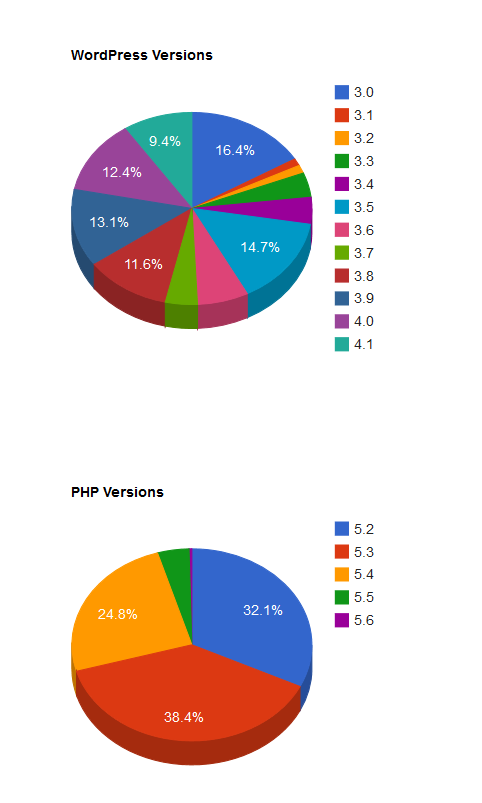
The only thing I can reference to the painful leap is WordPress’ backwards compatibility. After all, it’s only an 11-year-old software project (turns 12 in May). It’s one of the primary reasons it’s been able to achieve such a high market share. A look at the minimum requirements page tells you all you need to know.

The charts on WordPress’ About page display WordPress and PHP versions in use are visual reminders of the sad state of affairs.

YUMMY WordPress Pie Charts!

YUMMY WordPress Pie Charts!

Supporting old versions of PHP continues to be a pain point for WordPress. However, according to one individual, worrying about PHP versions isn’t important if you’re creating the next WordPress or something that’s just as impactful.

If you think the version of PHP is important at all, you’re not going to create the next WordPress, meaning the next thing that’s as big or impactful as WordPress is.

The quote makes it seem like the next WordPress is likely to be some sort of SaaS offering like Wix, Weebly, or SquareSpace. When I wrote about what could lead to the downfall of WordPress late last year, a competitive service was not one of the choices. Now I think if anything were to disrupt WordPress, it would be a SaaS offering.

Outside of backwards compatibility, I don’t know any other painful leaps WordPress has to make in order to get to 50% market share. Perhaps Mullenweg could enlighten us with a listicle on his personal site.

A Few Thought Experiments

What got us here isn’t going to get us there. Once we get to 50%, we can decide something new we want to do – Matt Mullenweg

What processes and changes will evolve to get us there? How much internal friction will there be? It’s mind bending to think about what WordPress would need to be to people in order to gain 50% or more of market share. It’s a an enormous amount of websites/people and if WordPress can’t be all things to all people, who makes up the majority of a 50% market share userbase?

The Rise of Social Co-working Spaces in Exotic Locations

‘More young people want work-life balance,” she said. “Maybe vacations completely unconnected are not feasible anymore; maybe people won’t take traditional vacations. But they can go to work in paradise for two months.’

Companies, too, are drawn to the intimate communal areas, amenities and activities of co-working/co-living spaces. Nine remote-working employees of Automattic, a web development corporation gathered for a work meetup this month at the Surf Office in Gran Canaria, taking over the 10-room property for six days “to build relationships, have real-time interaction and also work on projects that are best done in person,” the company said.

The New York Times on the rise of social co-working spaces in exotic locations. Co-working in nice places is a treat for distributed workers, but I bet having people with similar interests in the same space exponentially enhances a person’s productivity instead of being a lone wolf. Maybe I just like saying I work alone with my most badass voice.

My Use of Facebook and WordPress Intertwined

I’ve used Facebook for a long time and most of my friends are people who I’ve worked with or know in real life. Recently, I’ve accepted a number of friend requests from people I routinely interact with in the WordPress world. It was a tough decision and one I don’t take lightly.

For the past few years, I’ve kept Facebook at a point where the only people I’ve accepted as friends are those I consider actual friends and know in person. My Facebook feed is completely different from my WordPress persona. I share pictures of what I have for dinner, food I eat, things I discover, pictures of my dog and wife, etc. It definitely represents more of who I am as a person versus a blog or Twitter.

I’m on the fence whether I should allow so many people to see deeper into my everyday life. It’s something I’m struggling with. I don’t want personal Facebook relationships to creep into my work. I’m friends with some of the people and companies I write about all the time on a major publication. I certainly wouldn’t want a conflict of interest thing to come up or something more sinister.

Since accepting a number of friend requests from those in the WordPress community, my timeline has blown up. In several instances, I’ve removed their feeds from my timeline but have remained friends. This has given me the best of both worlds: Following the people I care about while showing everyone else what I’m up to.

We’ll have to see how this goes as a lot more people in the WordPress realm know what’s going on in my life. I know for a fact that at the first sign of a conflict of interest, I’m unfollowing everyone on Facebook that has anything to do with WordPress.

The last thing I need is a bunch of Facebook/WordPress BS in my Facebook life. No thank you!

American Nomads Documentary by BBC

Really enjoyed this documentary from the BBC on American Nomads. It features everything from  tramps, oogles, hobos, and elderly snow birds. Just about all of them have one thing in common, getting away from the responsibilities of life.

In many ways, it’s something I wouldn’t mind experiencing for myself but then again, maybe not. There’s something enticing about living life with no rules, responsibilities, or ties to anything.

Struggling Hard to Get My Groove Back

photo credit: rthakrar - cc

photo credit: rthakrarcc

I don’t know if it’s one thing or a combination of factors, but when it comes to writing about WordPress, I’m really struggling to get my groove back. Things felt so much easier back in 2009-2011 when I  was publishing multiple stories per day without breaking a sweat. Today, it’s tough for me to get 1-2 articles written let alone three or four.

If I think back to the environment I was in during that time, I worked the late night shift at the store. I would come home, maybe write an article or two or get up late, and write some more. I was in tune with most of what was going on in the WordPress ecosystem. I’d read my FeedReader and interact with people throughout the day via Twitter. Each day felt like I was one step closer to accomplishing something which at the time, was turning the site into my full-time job.

I was focused, lived with my parents, and spent most of my time in my room and just wrote about whatever interested me regarding WordPress. I’m trying to figure out what happened to that Jeffro. If you find him, can you tell him to go home as he’s late for dinner?

Today, I spend a lot of time sitting in this chair, TRYING to write about whatever interests me in WordPress and it’s not working. My reading to writing ratio is way off. I spend a lot more time writing than I do reading, I’m almost certain it’s one of the factors plaguing me. I rarely look at my FeedReader and when I do read, I’m skimming to hurry up and write a post. Posts which have in my opinion, been total crap. I feel like that guy who had a good thing going, retired, came out of retirement and could never repeat the success that made him who he is.

Here are a couple of instances where I’ve had good days.

  • I wake up with post ideas already in mind, I have my day set and all I need to do is write about those topics instead of finding things to write about.
  • I work remotely at my favorite spot. When I work from the MacbookPro, I’m forced to stay focused on the task at hand since I only have one screen. It takes longer to write the content but I’m generally more focused.
  • I’m able to get my work done and spend time with my wife.
  • Mondays, Tuesdays, and Wednesdays are my best days

Things I definitely need to change.

  • I need to get a membership to the local rec center and actually perform physical activity. I keep telling myself that not only will this give me the opportunity to work out, but I’ll be able to listen to podcasts again, something I’ve missed since quitting my previous job.
  • I need to lose weight. The pounds keep piling on and I’ve done little to stop the madness.
  • I need to cut down my beer and pop intake, two things which I know are significant contributors to the decline of my health.

Things I’m still struggling with being a full-time distributed worker.

  • Knowing how or when to end the work day. I’m spending a lot of time on the computer but not having a lot to show for it. It doesn’t help that on days where I’ve had a hard time producing content, it almost forces me to keep working until I do.
  • Discipline.
  • The quality of the output I’m producing needs to be better.
  • Getting at least one if not two good posts published every day. WHY IS THIS SO HARD NOW?
  • Thursdays and Fridays are my worst days of the week. I’m almost certain I know why and I’m going to change it.

No one needs to tell me I’m doing a bad job, I’m pretty good at discovering that on my own. Besides, as a distributed employee, I’m my own boss and my own worst critic. What I need is encouragement for when I’ve done a good job. Hell, I don’t even know what constitutes a good job. It’s something I’ve made up rarely achieve.

Just like iteration is the continuous improvement of something, I need to keep iterating my process, routine, and attitude. Changes need to happen because I certainly don’t have the winning combination right now.